Now comes the gloaming, for day will end, and the stream, its flow stilled and gathered up, so that trees growing firmly on its banks, their barks white, their trunks bent, their branches covered with leaves and reaching up, up, are reflected in the depths, awaits the eye, the hand, the foot that shall then give all this a meaning.
—Jamaica Kincaid, At the Bottom of the River
The Essequibo River stretches more than 1,000 kilometres across Guyana. Its source is found in the foothills of the Acarai Mountains, located near the Guyana-Brazil border. Its terminus at the Atlantic Ocean lies just twenty-five kilometres west of Georgetown, Guyana’s capital. The character of the Essequibo changes dramatically as it flows northward, in some places the river is shallow and narrow, in others it is deep and as much as thirty-kilometres wide. At times the water moves ferociously through the river’s rapids, while elsewhere it runs still, reflecting the sky like a mirror. The Essequibo is brown in colour, stained by the tannins from leaves that fall from the vast rainforests that surround much of it and the rich silt and sediment in its bed. Its surface is opaque, obscuring from view much of what lies beneath.
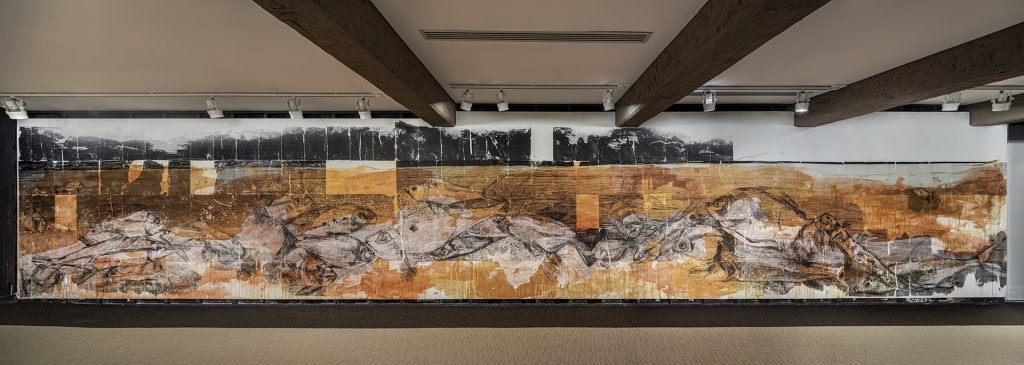
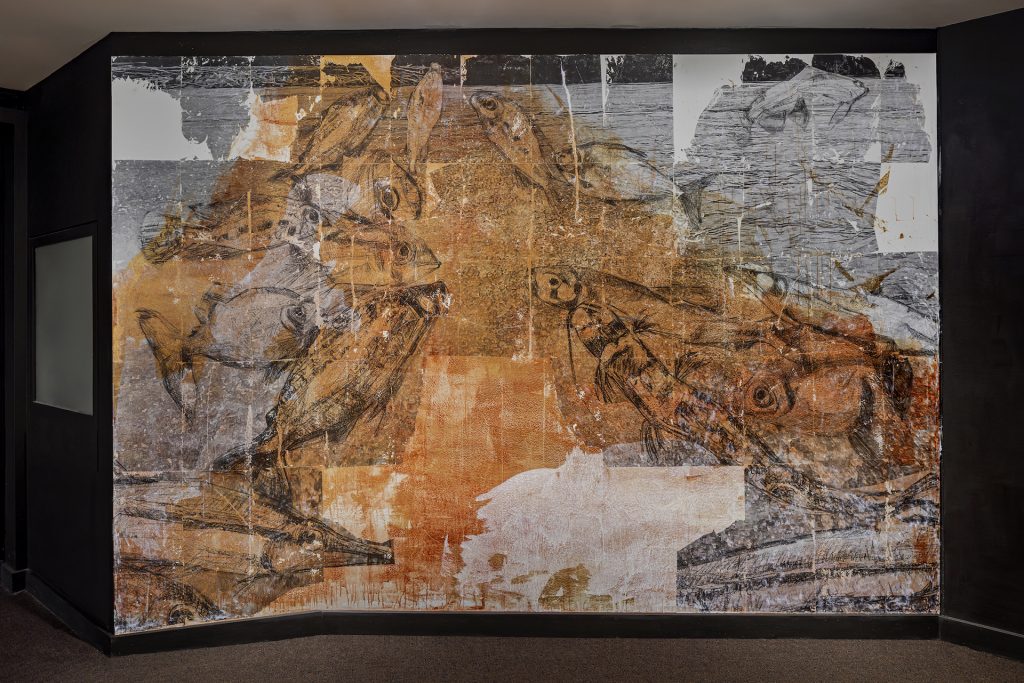
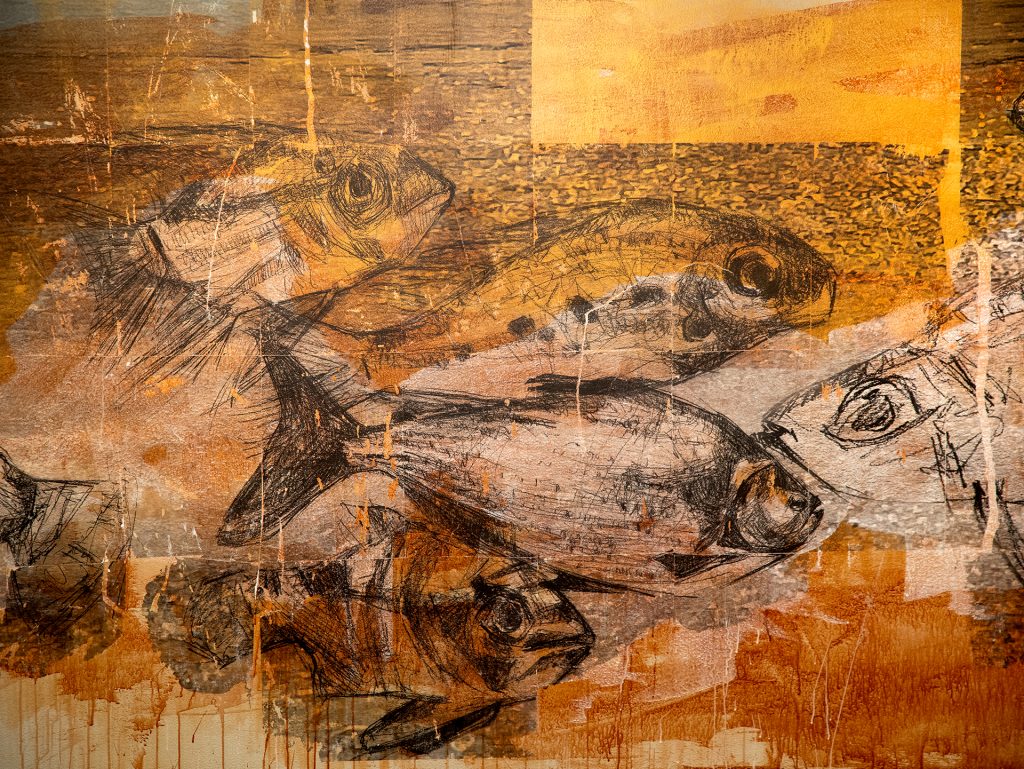
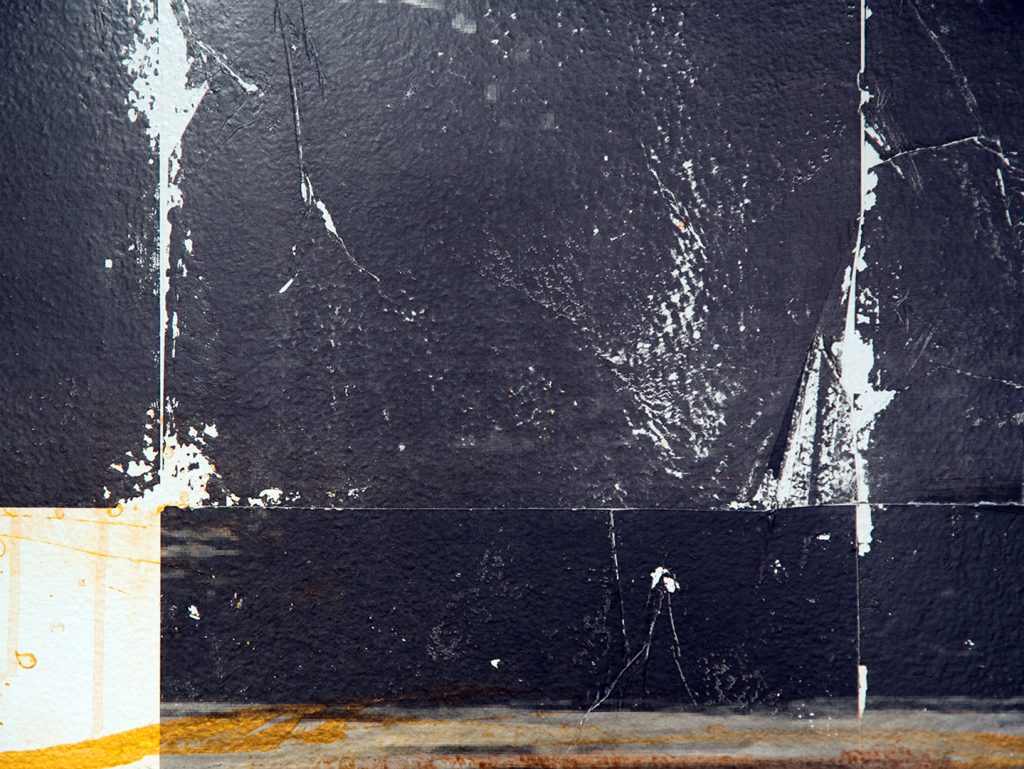
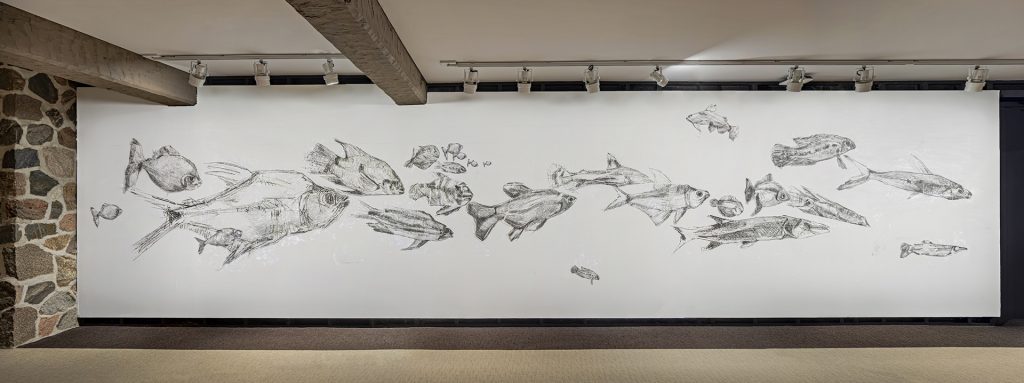
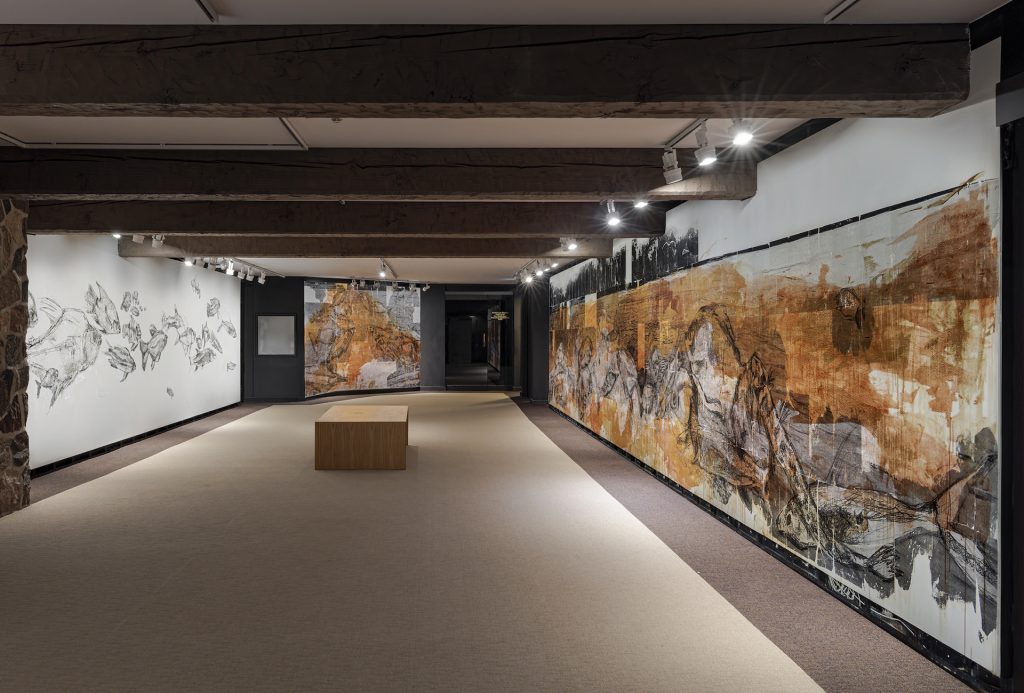
Sandra Brewster’s site-specific project FISH dives under the surface of the Essequibo and finds a subject in the diverse freshwater fish that make their home in its waters. More than three hundred species of fish live in the Essequibo and its many tributaries, including some sixty endemic species, found nowhere else on earth. Using a carefully honed gel transfer technique, Brewster wraps gallery walls in black and white photos of the Essequibo. The delicate process of transferring the image from printed sheets of paper to the wall leaves behind traces—folds, tears, shifts, and gaps—that evoke a worn, treasured memento or the incomplete quality of memories. Brewster’s panoramic vistas are punctuated by gestural drawings of the fish that swim and surge in the dramatic waters of the river. Here, Brewster celebrates and honours the diverse life of the river, big and small, native and invasive, predator and prey.
Brewster heard about the Essequibo River long before she ever saw it. Described in stories told by her parents, who immigrated from Guyana to Canada in the late 1960s, the river— vast, dark and impenetrable—has become, for Brewster, a rich metaphor. The river, with its many bends, islands, and tributaries, is difficult to navigate and one’s journey on it cannot be fully anticipated or planned. Brewster’s work reveals that these unforeseeable journeys on the Essequibo are not unlike the experiences of those who move from a known place to an unknown one.
Beneath the surface, however, lies another story. The Essequibo has long provided a rich habitat for fish, which thrive in its murky depths, surging rapids, and silty banks. Here, Brewster presents a variety of the fish species that have adapted to this unique body of water and navigate its idiosyncrasies from below. While each fish is a product of the same environment, they are unique and their movements are guided by distinct motivations and intentions, not unlike the people who live on the land above. The individual fish are also part of a community of sorts, nourished by the river and, here, moving together through rushing water. The fish belong to the river and the river belongs to them.
– John Geoghegan, Associate Curator, Collections and Research, McMichael